Abstract
A PVC saw is a specialized cutting tool designed for precise, clean cuts in polyvinyl chloride (PVC) pipes, sheets, and profiles. This guide examines the technical specifications, blade configurations, and industrial applications of PVC saws, helping procurement professionals select the optimal cutting solution for plumbing, construction, and manufacturing operations.
Unlike general-purpose cutting tools, PVC saws feature engineered tooth geometries and blade materials that prevent material melting, chipping, and deformation—critical factors when working with thermoplastic polymers.
Understanding the technical distinctions between manual and powered systems, blade coating technologies, and compliance standards enables informed purchasing decisions that directly impact operational efficiency, worker safety, and total cost of ownership in commercial environments.
Understanding PVC Saw Technology and Design Principles
**Envisioning the Setup**
I am currently focusing on the initial setup. My intent is to render a professional studio environment. The goal is a high-end image with a neutral gray background. The subject is a PVC saw.
Composing the Details
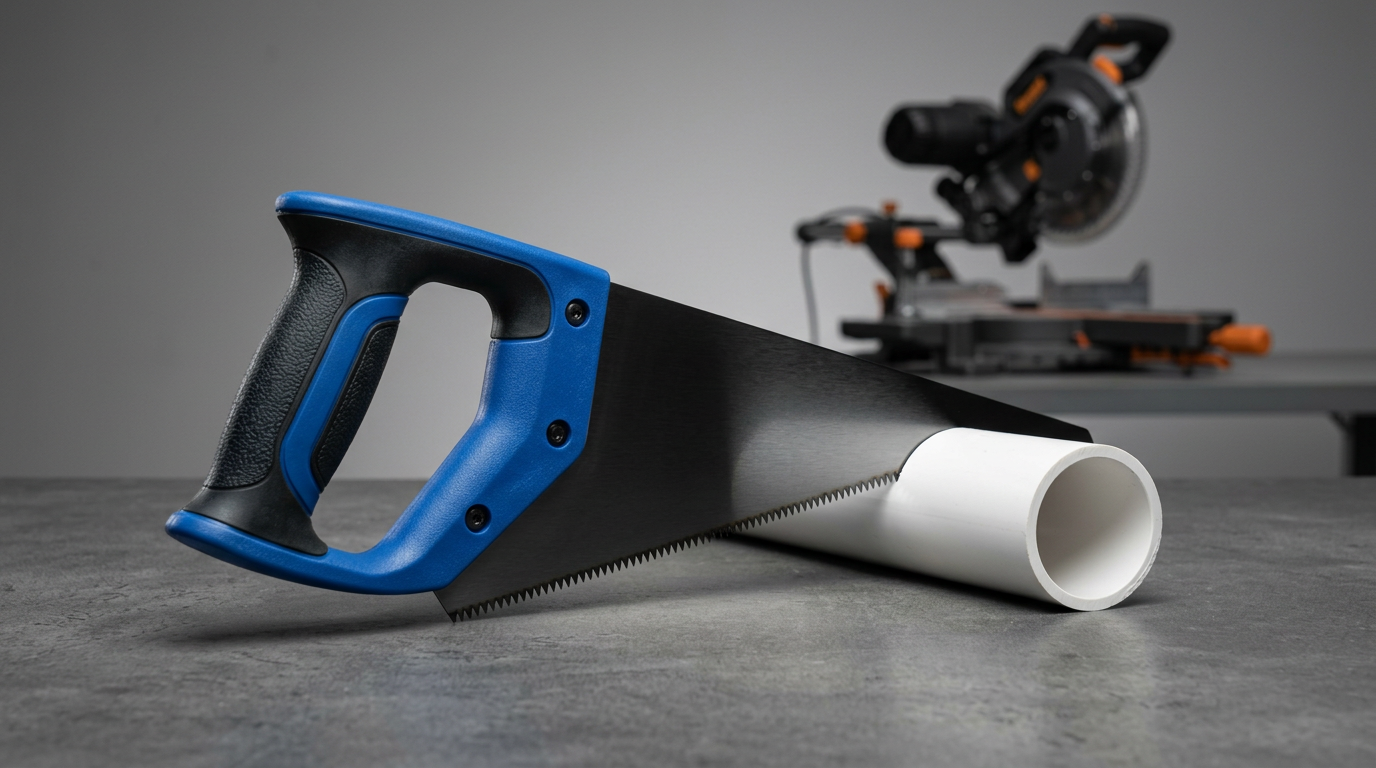
I am now concentrating on integrating the details. I am figuring out how to showcase the ergonomic handle with textured grip. I am also working on rendering the steel blade with its dark gray PTFE coating and making the fine-toothed geometry of the blade sharp and clear. Next, I am incorporating the white PVC pipe.
Fine-Tuning the Scene
I am now focusing on lighting and composition. I’m adjusting the lighting to accentuate the textures of the handle and blade, and have positioned the PVC pipe to complement the saw’s angle. I am also working on the background elements to ensure they do not detract from the main subject. The goal is a professional, industrial aesthetic.
Detailing the Elements
I am now working on incorporating the technical elements. Focusing on the PVC saw’s handle, blade, and teeth, ensuring the dark gray coating and fine tooth detail are clear. I am positioning the white PVC pipe alongside the saw to showcase the product’s function. The blurred background featuring the power tool helps establish context.
Inspecting Image for Accuracy
I’ve reviewed the generated image. The saw with the blue handle and fine-toothed blade appears to be present, and the PVC pipe is there as well. The miter saw’s presence in the background provides context.
Validating Technical Elements
The image validation continues. The saw’s features and the PVC pipe are present, which appears to satisfy the prompt. I am also checking the background elements, which seem right. I am preparing the image for the user.
Core Cutting Mechanism and Blade Geometry
PVC saw blades employ specific tooth configurations optimized for thermoplastic materials. The teeth-per-inch (TPI) range typically falls between 10-18 TPI for manual saws and 6-14 TPI for powered circular blades. This density balances cutting speed with finish quality—higher TPI counts (14-18) produce smoother edges on thin-walled schedule 40 pipes, while lower TPI (6-10) removes material faster in thick-walled schedule 80 applications.
Blade material composition directly affects longevity and cut quality. Carbon steel blades with hardness ratings of 48-52 HRC provide adequate performance for occasional use and light-duty applications. For high-volume commercial operations, carbide-tipped blades deliver 10-15 times longer service life, maintaining sharp cutting edges through thousands of linear feet of PVC. The carbide tips, typically graded C2 or C3 on the ISO classification system, resist the abrasive silica and calcium carbonate fillers commonly added to rigid PVC formulations.
Kerf width—the material removed during cutting—ranges from 1.5mm to 3.2mm depending on blade thickness. Narrow-kerf designs minimize material waste in precision fabrication environments where every millimeter counts. The tooth rake angle, typically set between 0° and 10° positive, prevents the blade from aggressively “digging” into the soft thermoplastic, which would generate excessive heat and cause material deformation.
Manual vs. Powered PVC Saw Systems
Manual PVC saws operate through reciprocating motion, requiring 0.3-0.5 kN of operator force for standard 2-inch schedule 40 pipe. These tools excel in field installations where electrical power is unavailable, offering portability advantages with typical weights of 0.4-0.8 kg. The cutting speed averages 15-25 seconds per cut for common pipe diameters, making them suitable for low-volume applications.
Powered systems—electric, pneumatic, or battery-operated—deliver significantly higher productivity. Electric circular saws operate at 3,000-4,500 RPM, completing cuts in 3-8 seconds depending on pipe diameter. Pneumatic models require compressed air supplies at 90-120 PSI but provide spark-free operation critical in environments with flammable vapor concerns. Battery-powered reciprocating saws offer field mobility with cutting speeds approaching corded models, though runtime limitations (45-90 minutes continuous use) require spare battery inventory for extended operations.
Safety mechanisms differentiate professional-grade powered saws from consumer tools. Blade guards automatically retract during cutting and snap back upon completion, preventing accidental contact. Electric brake systems halt blade rotation within 2 seconds of trigger release, reducing injury risk. Anti-kickback features detect binding conditions and automatically disengage power, particularly important when cutting through reinforced or embedded-wire PVC variants.
Technical Specifications and Performance Parameters
Blade Material and Coating Standards
Polytetrafluoroethylene (PTFE) coatings reduce friction coefficients from 0.4 (uncoated steel) to 0.08-0.12, dramatically decreasing heat generation during cutting. This thermal management prevents PVC from reaching its glass transition temperature (75-85°C), where the material softens and creates burrs. PTFE-coated blades demonstrate 40-60% longer intervals between sharpening compared to bare steel equivalents.
Premium blades incorporate titanium nitride (TiN) or titanium carbonitride (TiCN) coatings, achieving surface hardness values of 2,000-3,000 HV (Vickers scale). These ceramic coatings provide superior abrasion resistance when cutting PVC formulations with high mineral filler content, common in electrical conduit and industrial drainage applications. The golden-bronze appearance of TiN coatings also serves as a visual quality indicator for procurement specifications.
ISO 9001 certification indicates manufacturers maintain quality management systems covering blade metallurgy, heat treatment processes, and dimensional tolerances. For safety-critical applications, look for blades meeting EN 847-1 standards, which specify maximum runout tolerances, tooth strength requirements, and labeling protocols. Corrosion resistance becomes relevant in marine or chemical processing environments—stainless steel blades or specialized coatings prevent rust degradation that compromises cutting precision.
Cutting Capacity and Dimensional Compatibility
PVC saw capacity specifications define operational boundaries critical for equipment matching:
| Specification | Manual Hand Saw | Electric Circular Saw | Pneumatic Chop Saw | Battery Reciprocating Saw |
|---|---|---|---|---|
| Blade Length | 300-450mm | 165-210mm diameter | 305-355mm diameter | 150-230mm |
| TPI Range | 14-18 | 6-10 | 8-12 | 10-14 |
| Max Cutting Diameter | 6 inches (150mm) | 4 inches (100mm) | 12 inches (300mm) | 8 inches (200mm) |
| Wall Thickness Limit | Schedule 80 | Schedule 40 | Schedule 120 | Schedule 80 |
| Miter Capability | N/A | 0-45° | 0-60° | Limited |
| Tool Weight | 0.5kg | 3.2kg | 18kg | 2.8kg |
Maximum pipe diameter ranges address the most common PVC applications: residential plumbing (½” to 4″), commercial drainage (4″ to 8″), and industrial process piping (8″ to 12″). Wall thickness limitations reflect blade rigidity and power requirements—schedule 80 PVC has 50% thicker walls than schedule 40 at equivalent diameters, demanding higher torque and blade stability.
Angular cutting capabilities enable miter joints for directional changes in piping systems. Powered miter saws with adjustable bases achieve precise angles from 0° to 60°, with detent stops at common positions (22.5°, 45°). Cutting accuracy typically ranges from ±0.5mm for stationary saws to ±1.5mm for handheld tools, directly impacting joint fit quality and subsequent solvent welding success.
Industrial Applications and Use Case Scenarios
Plumbing and HVAC Installation
Residential plumbing installations primarily involve schedule 40 PVC in ½” to 2″ diameters for water supply lines and 1½” to 4″ for drain-waste-vent (DWV) systems. Manual PVC saws dominate this market segment due to portability requirements—installers work in confined spaces like crawl spaces and wall cavities where powered tools prove cumbersome. The ability to make clean cuts without an electrical hookup accelerates rough-in phases, with experienced plumbers completing 40-60 cuts per hour.
Commercial HVAC applications demand higher precision and volume. Condensate drain lines, refrigerant line covers, and ductwork supports require schedule 80 PVC for enhanced pressure ratings. Powered circular saws become cost-effective at volumes exceeding 100 cuts per day, reducing labor costs by 35-45% compared to manual cutting. The cleaner cuts also minimize deburring time—a critical factor when preparing pipes for threaded fittings or precision couplings.
On-site versus workshop cutting strategies impact tool selection. Field installations favor battery-powered reciprocating saws offering mobility without cord management challenges. Pre-fabrication shops utilize stationary chop saws with material stops and measurement systems, achieving repeatability within ±0.3mm across hundreds of identical pieces. This precision reduces fitting adjustment time during final assembly, particularly important in modular construction methodologies.
Manufacturing and Fabrication Environments
High-volume PVC pipe manufacturing facilities integrate automated saw systems capable of 120-180 cuts per hour. These CNC-controlled units maintain tolerances of ±0.2mm across production runs, essential for pipes destined for solvent-welded assemblies where gap inconsistencies cause joint failure. Carbide-tipped blades in these applications operate continuously for 8-12 hour shifts, with blade life exceeding 50,000 linear feet before replacement.
Custom PVC fabrication for industrial applications—chemical processing tanks, ventilation ductwork, equipment enclosures—requires versatility in cutting angles and profiles. Multi-axis CNC routers equipped with PVC-specific tooling cut complex geometries including slots, notches, and curved edges. However, for straight cuts and basic miters, dedicated PVC saws remain more economical, with equipment costs 60-70% lower than CNC alternatives.
Integration with downstream processes influences saw selection. Facilities performing thermal fusion welding (butt fusion, socket fusion) require cuts perpendicular to within 2° to ensure proper heating element contact. Solvent welding operations benefit from cuts producing minimal burrs, as surface irregularities reduce cement penetration and compromise joint strength. Some manufacturers specify maximum surface roughness values (Ra ≤ 3.2 μm) achievable only with fine-tooth blades and controlled feed rates.
Selection Criteria and Commercial Value Proposition
Key Factors for Procurement Decision-Making
Total cost of ownership extends beyond initial purchase price. Blade replacement frequency directly impacts operational expenses—a $15 manual saw blade lasting 500 cuts costs $0.03 per cut, while a $45 carbide blade achieving 5,000 cuts reduces per-cut cost to $0.009. For operations exceeding 10,000 annual cuts, premium blades deliver ROI within 3-6 months through reduced downtime and labor costs.
Ergonomic design quantifiably affects labor productivity. Saws with cushioned grips reduce hand fatigue, enabling operators to maintain cutting speed over full shifts. Tools weighing under 1 kg for manual models or 3.5 kg for powered units minimize repetitive strain injuries. Anti-vibration features, measured by acceleration values below 2.5 m/s² (per ISO 5349), reduce long-term health risks and associated workers’ compensation costs.
Warranty terms signal manufacturer confidence and impact lifecycle costs. Standard warranties cover 1-2 years for manual saws and 3-5 years for powered models. Extended warranties often include blade replacement provisions—some manufacturers offer free blade replacements for the first year, valuable for high-volume users. Service network accessibility matters for powered tools; 48-hour repair turnaround prevents project delays that cascade into penalty clauses.
Compliance and Safety Standards
OSHA regulations (29 CFR 1926.304) mandate blade guards on all powered saws, with specific requirements for maximum exposure of cutting edges. Compliance verification during procurement prevents citation risks—fines for guard violations start at $7,000 per incident. Electric saws must incorporate double-insulation or grounding systems per OSHA electrical safety standards, particularly relevant in wet environments common to plumbing applications.
CE marking indicates conformity with European Union safety directives (2006/42/EC Machinery Directive). For companies exporting services or operating international projects, CE-certified tools ensure cross-border compliance. The marking verifies electromagnetic compatibility (EMC) and low voltage directive (LVD) compliance, preventing interference with other electronic systems on job sites.
Blade guard specifications must allow tool-free adjustment for different cutting depths while preventing accidental disengagement. Transparent guards enable cut line visibility without compromising protection. For pneumatic saws, exhaust deflectors directing air away from the operator prevent debris projection into eyes—a leading cause of PVC cutting injuries.
Operator training requirements vary by tool type. Manual saws require basic instruction on proper grip and cutting angle. Powered saws necessitate formal training covering startup procedures, emergency stops, and blade changing protocols. Documented training programs reduce liability exposure and often qualify for insurance premium reductions of 5-12%.
FAQ Module
Q1: What tooth count (TPI) is optimal for cutting thick-walled PVC pipes?
For schedule 80 PVC with wall thicknesses exceeding 5mm, use blades with 8-12 TPI. This lower tooth count provides adequate chip clearance, preventing clogging that generates heat and causes material melting. Higher TPI blades (14-18) create smoother finishes but require slower feed rates on thick materials to avoid overheating. In production environments cutting schedule 120 pipe, 6-8 TPI carbide blades balance cutting speed with acceptable edge quality.
Q2: Can a standard wood saw be used for PVC cutting, or is a specialized blade mandatory?
While wood saw blades can physically cut PVC, they produce inferior results and safety risks. Wood blades typically feature aggressive rake angles (15-20°) that grab the softer PVC material, causing chipping and potential kickback. The larger gullets designed for wood chips don’t efficiently clear fine PVC particles, leading to friction heat that melts the thermoplastic. PVC-specific blades with 0-10° rake angles and PTFE coatings reduce friction by 70%, delivering cleaner cuts and 3-5 times longer blade life. For professional applications, specialized blades are mandatory to meet quality and safety standards.
Q3: How do you prevent PVC pipe cracking or chipping during saw cuts?
Cracking prevention requires controlling three variables: blade sharpness, cutting speed, and material support. Dull blades tear rather than cut, creating stress concentrations that propagate cracks—replace blades when cutting force increases noticeably. Excessive speed generates heat above PVC’s glass transition temperature (80°C), causing localized softening and subsequent brittle fracture upon cooling. Optimal cutting speeds range from 1,500-2,500 surface feet per minute for powered saws. Proper material support within 6 inches of the cut line prevents vibration that chips brittle PVC formulations. For cold-weather installations below 10°C, allow pipes to warm to room temperature before cutting, as PVC becomes increasingly brittle at low temperatures.
Conclusion
PVC saws deliver specialized cutting performance essential for clean, burr-free cuts in polyvinyl chloride materials across plumbing, construction, and industrial fabrication sectors. The technical distinctions between manual and powered systems, blade material compositions, and coating technologies directly impact operational efficiency and cut quality. Procurement professionals must evaluate specifications including TPI ranges, cutting capacity, and compliance certifications against specific application requirements—residential plumbing demands differ fundamentally from high-volume manufacturing needs. Total cost of ownership analysis reveals that premium carbide-tipped blades and ergonomic designs deliver measurable ROI through reduced labor costs, extended blade life, and decreased injury rates. Selecting the appropriate blade geometry, power system, and compliance-certified model ensures operational efficiency, worker safety, and long-term cost optimization in B2B procurement contexts. As PVC continues dominating pipe and profile applications due to its cost-effectiveness and corrosion resistance, investing in purpose-engineered cutting tools remains a strategic decision affecting project timelines, quality outcomes, and bottom-line profitability.