Article Summary:
Tin snips and aviation snips are both important hand tools in the metal-cutting process; however, they differ in design, mechanical advantage, cutting precision, and intended professional use.
References to classical handtool design, like the Handbook of Machinery (Industrial Press), the Sheet Metal Handbook by Ron Fournier, and ergonomic research in Applied Ergonomics, the geometry of the tools and their leverage mechanisms have an effect on the efficiency of the cut, fatigue, and control of the material.
This article provides a comprehensive, industry-oriented analysis of tin snips and aviation snips, they have a historical origin, mechanical design, cutting mechanism, material properties, ergonomic performance, and professional uses.
Referenced literature and technical sources include:
- Machinery’s Handbook, Industrial Press
- Fournier, R., Sheet Metal Handbook, HPBooks
- Applied Ergonomics Journal – Hand tool fatigue and leverage studies
- ANSI & DIN hand tool standards documentation
Why the Difference Between Tin Snips and Aviation Snips Matters?
Initially, tin and aviation snips appear to be interchangeable. Both of these cutting tools are manual and are primarily used for sheet metal; they are also frequently marketed in the same category. However, in professional environments, such as the HVAC industry, metal manufacturing, roofing, and industrial maintenance, these tools are often misused, which results in inefficiency, poor cut quality, and injury.
Understanding the distinction between tin snips and aviation snips is not simply a matter of terminology.
It demonstrates greater distinctions in the evolution of tools, mechanical assistance systems, and modern consumer demands.
For both professionals and B2B buyers, choosing the appropriate tool has an effect on productivity, tool waste, and long-term user comfort.
What Are Tin Snips? A Technical Definition
Tin snips are traditional hand tools that are used to cut thin sheets of metal with a similar scissor-like action. Traditionally, they were created during the uptick in the use of tinplates in roofing, food containers, and household goods.
tin’s primary attributes include:
- Direct or slightly curving blades
- Direct the pivot point without taking advantage of compound leverage.
- Easy toforge or stamped creation
Despite their reputation, tin snips are employed for a variety of purposes. They’re typically employed on aluminum, copper, brass, and thin steel sheets with a thickness of 0.25 mm or less.
The singular trait of tin snips is their simple design, both mechanically and structurally.
Historical Evolution of Tin Snips
Tin snips became prevalent in the 18th and 19th centuries alongside the increase in sheetmetal manufacturing. Early drafts were often made by hand, featuring prominently:
- Forged steel blades with carbon as their main element
- Pivoted joints that are riveted
- Minimalist’s ergonomic design
At that time, materials were less dense, and the demands for cutting were less severe. The direct-leverage mechanism was effective for simple cuts and light streams.
However, as the thickness of industrial sheets of metal increased and their diversity increased, the traditional limitations of tin snips became more significant.
What Are Aviation Snips?
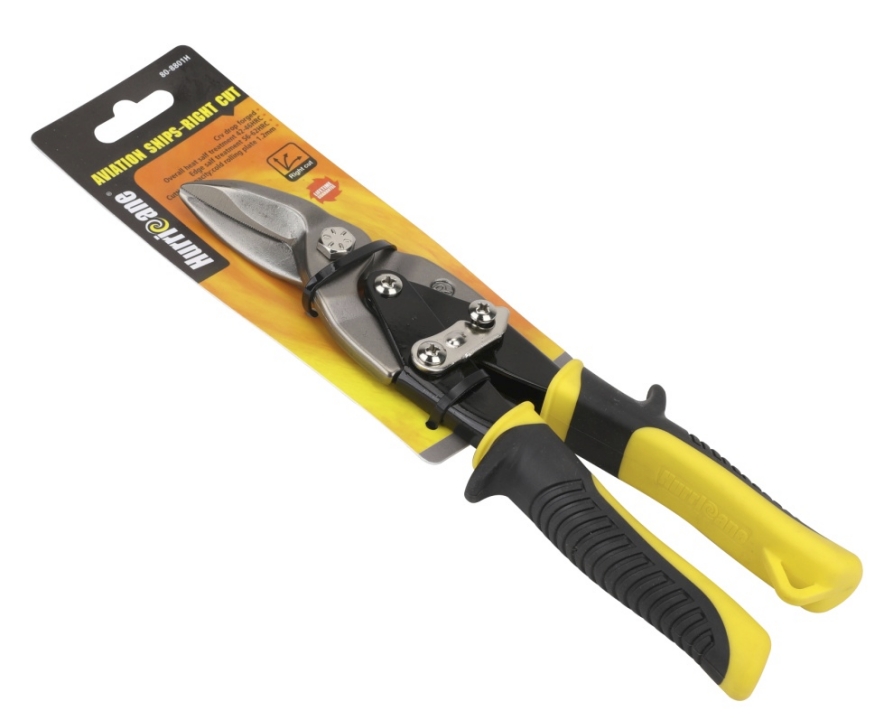
Aviation snips are a modern iteration of tin snips that are intended to address the increasing popularity of industrial metal slicing. Despite the name, aviation snips are not limited to manufacturing aircraft; the term derives from their early use in the manufacture of aircraft sheets.
Aviation snips are characterized by:
- Combined debt mechanisms
- Shorter, more powerful blades
- Advantageous ergonomically contoured handles
These attributes have a dramatic effect on the cutting force while also decreasing the fatigue associated with the hand, making aviation snips appropriate for thicker and harder materials.
Why Are They Called “Aviation” Snips?
The term “aviation snips” was derived from early 20th-century aircraft design, the purpose of which was to have precise, controlled cutting that did not distort. Traditional tin snips struggled with the requirements.
Snips that had multiple levers allowed technicians to:
- Maintain the accuracy of the cut.
- Reduce the amount of warping in the material.
- To work for a longer period of time without experiencing fatigue.
Eventually, these instruments became common in the HVAC, automotive, and metal manufacturing industries.
Mechanical Difference: Direct Leverage vs Compound Leverage
The primary difference between tin snips and aviation snips is the mechanical advantage.
Tin snips have a single critical point of rotation, which means that the force used to cut is directly related to the strength of the hand. Aviation straps employ a multiple-talking system that increases the force applied at multiple different points of pivotal motion.
This mechanical distinction clarifies:
- Why do aviation professionals have to deal with thicker metal?
- Why do tin slices have a more effective feedback regarding touch?
- Why has the aviation industry reduced the strain of long sessions of work?
Cutting Precision and Control
Tin snips have a more direct feel when cutting. Skilled users often appreciate them for:
- Direct long cuts
- Metals with a light color
- Situations that require precise oversight
Aviation snips have a greater capacity, but they also feel less vulnerable because of their leverage. However, their blade design averts this by keeping the path of the cut blade consistent, especially on bends.
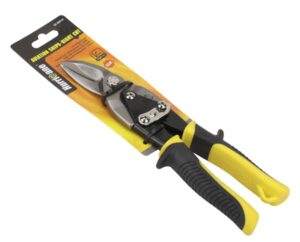
Blade Geometry and Cutting Path
Tin snips typically feature:
- Longer blades
- Narrow cutting angles
Aviation snips usually have:
- Shorter blades
- Reinforced cutting edges
- Serrations to prevent slippage
These differences directly affect cut behavior, edge finish, and material deformation.
Directional Cutting Capabilities
Aviation snips are commonly color-coded:
- Green: right-hand cuts
- Red: left-hand cuts
- Yellow: straight cuts
Traditional tin snips generally lack this specialization, limiting their effectiveness in complex cutting paths.
Material Compatibility
While both tools can cut sheet metal, their optimal ranges differ significantly.
Tin snips are best suited for:
- Thin aluminum
- Soft copper
- Brass sheets
- Light-gauge steel
Aviation snips handle:
- Thicker galvanized steel
- Stainless steel (thin gauge)
- Aluminum alloys
Ergonomics and User Fatigue
Ergonomic studies published in Applied Ergonomics indicate that compound-leverage tools significantly reduce cumulative hand strain.
Aviation snips are designed with:
- Spring-loaded handles
- Non-slip grips
- Optimized handle angles
Tin snips lack many of these features, making them less suitable for extended use.
Durability and Maintenance
Tin snips:
- Simpler construction
- Easier to sharpen
- Fewer moving parts
Aviation snips:
- More complex mechanisms
- Require periodic lubrication
- Generally longer service life under heavy use
Manufacturing Standards and Quality Indicators
Professional-grade tin snips and aviation snips typically comply with:
- ANSI hand tool standards
- DIN steel hardness specifications
Inferior tools often fail due to:
- Blade chipping
- Pivot loosening
- Handle deformation
Comparison Table: Tin Snips vs Aviation Snips
| Feature | مقصات القصدير | Aviation Snips |
| Leverage System | Single pivot | Compound leverage |
| Cutting Force | محدودة | High |
| Precision Feel | High | Moderate |
| Fatigue Reduction | Low | High |
| Best For | Light, straight cuts | Heavy, curved cuts |
| Skill Dependency | High | Moderate |
Industry Applications
Tin Snips: Traditional Method of Work
Tin snips are primarily employed for:
- Gauge cut light sheetmetal
- Direct or indirect, linear reductions
- Ductwork, flashing over the roof, and general metal construction
- Do it yourself and light up the industrial tasks
They have the greatest success when:
- The thickness of the material is average
- Precision isn’t necessary
- The space allows for complete motion of the hand
Aviation Snips: Accuracy and Control
Aviation snips (compound action snips) are commonly employed in:
- HVAC setup and routine maintenance
- Body repairs for the automotive industry
- Aircraft sheetmetal employment
- Electrical enclosures and metal caskets
Key benefits in professional environments:
- More efficient in the cutting of thick materials.
- Precise definitions of left, right, and straight lines
- Reduced fatigue in the hand during routine tasks
Safety Considerations
| Aspect | مقصات القصدير | Aviation Snips |
| Hand fatigue | Higher over time | Significantly reduced |
| Control near edges | Moderate | High |
| Risk of slippage | Higher with thicker metal | Lower due to compound leverage |
| Cut-edge stability | Can warp metal | Cleaner, more controlled |
Best practices for both tools:
- Wear cut-resistant gloves
- Keep blades sharp to prevent slipping
- Use the correct snip orientation for the cut direction
Cost vs Performance Analysis
مقصات القصدير
Lower initial expense
Easy to construct
Adequate for sporadic or linear projects
Limitations:
Disparate power cutting
Faster operator depletion
Less accurate in predicting changes in direction
Air Snips
Increasing the price of purchases.
Mechanism with multiple actions
Increased long-term productivity
Value boost:
For those employed, reduced fatigue, healthier cuts, and fewer material errors often compensate for the higher initial cost.
Common Misconceptions
- “Aviation scissors are only appropriate for aircraft-related projects.”
In reality, they are common tools in HVAC, building, and manufacturing.
- “Tin can replace plastic.”
→ Tin snips have a hard time dealing with curves and thicker metals, which is why aviation snips are superior.
- The color of the blade affects the strength of the cut.
The coloring of the blade (left/right/ straight) indicates the direction of the cut, rather than the power of the blade.
How Professionals Choose Between Them?
Professionals typically choose based on the demands of the application, rather than the tool’s name.
Tin snips are most effective when:
Most of the cuts are simple
The materials are limited
Costs and simplicity are important
Aviation snips are most effective when:
Precision graphs are necessary
Thicker or more difficult metals are frequently
Long sessions that require a lot of effort lead to reduced fatigue.
Cleanliness of the edge and accuracy of the process have an effect on downstream endeavors.
FAQ: Tin Snips vs Aviation Snips
Are aviation screws a form of tin screws?
Yes, aviation snips are a modern, complex progression of traditional tin snips.
Is it possible to use tin foil to cut away stainless steel?
Only exceptionally thin gauge; aviation clips are more effective.
Why do airline employees have less fatigue?
Their collective debt is higher than their collective credit, which reduces the need to exert force.
Is the practice of using tin foil still important today?
Absolutely, this is especially true of light, exactness.
Which instrument is more appropriate for beginners?
Aviation snips have a lower difficulty level as a result of the lower force needed.
الخلاصة
The distinction between tin snips and aviation snips is attributed to mechanical engineering, economic evolution, and practical application in the real world. Tin snips are simple, controllable, and traditional, while aviation snips are powerful, efficient, and modern in design.
For experts, distributors, and businessmen, understanding these differences will lead to a better selection of tools, increased productivity, and a safer working environment.