Abstract:
Mechanical fastening systems are fundamental to modern engineering, from automotive assembly to aerospace manufacturing and household maintenance.
The principles of classical mechanics outlined in “Engineering Mechanics: Statics” by J. L. Meriam explain the fundamentals. Torque transmission theory, discussed in “Shigley’s Mechanical Engineering Design” by Richard G. Budynas, describes how rotational force (torque) applied through lever arms allows for controlled tightening and loosening of threaded fasteners. The effectiveness of torque application depends on lever length, contact geometry, friction coefficients, and material strength.
A wrench is a hand tool used in mechanics to grip, turn, tighten, or loosen fasteners like nuts and bolts by applying torque with a controlled lever mechanism.
Although it looks simple, the wrench is a carefully designed device that converts linear hand force into rotational mechanical advantage.
This detailed 2026 guide examines the physics, mechanical principles, material science, design variations, torque calculations, ergonomic considerations, industrial applications, manufacturing processes, quality standards, and buying criteria of مفاتيح ربط.
Introduction: Why the Wrench Remains a Core Mechanical Tool in 2026
Despite rapid advancements in automated fastening systems and electric torque drivers, the wrench remains one of the most essential tools in mechanical work. Its relevance spans:
- Automotive repair
- Industrial machinery assembly
- Construction
- Plumbing
- Aerospace maintenance
- DIY and home repair
The enduring importance of the wrench lies in its simplicity, reliability, and precision control. Unlike powered tools, a manual wrench allows direct tactile feedback, enabling controlled torque application without over-tightening sensitive fasteners.
In 2026, wrench technology has advanced with better alloys, ergonomic grips, coatings that resist corrosion, and systems for torque calibration, but the fundamental working principle still relies on classical mechanics.
What Is a Wrench? Technical Definition
A wrench is a mechanical tool operated by hand, created to exert torque on a fastener using a lever mechanism that connects to the fastener head through shaped jaws, rings, or sockets.
The main functional parts consist of:
- Handle (lever arm)
- Head (gripping interface)
- Jaw or ring shape
- Material body (for structural strength)
Its function is to transform the force applied by hand into rotational movement to tighten or loosen threaded parts.
How Does a Wrench Work? The Physics of Torque
The functioning of a wrench is controlled by torque mechanics.
Torque (T) is described as:
T = F × L
Where:
F = Applied force
L = Lever arm length
A longer wrench handle produces more torque for the same applied force.
This concept clarifies why longer wrenches are preferred for high-torque tasks.
Mechanical Advantage
A wrench offers a mechanical advantage by enlarging the effective radius from the pivot point (center of the bolt) to where the force is applied (end of the handle). This decreases the effort needed to turn a fastener.
When tightening a bolt:
- Thread friction opposes movement.
- Friction at the contact surface grows with torque.
- Applying the correct torque guarantees clamping force.
Using incorrect torque can lead to:
- Under-tightening (loosening).
- Over-tightening (thread stripping or bolt failure)
Torque vs Lever Length Example
| Lever Length | Applied Force | Resulting Torque |
| 100 mm | 50 N | 5 Nm |
| 200 mm | 50 N | 10 Nm |
| 300 mm | 50 N | 15 Nm |
This illustrates how increasing handle length increases torque output.
Major Types of Wrenches
There are various wrench designs created for different uses.
- Open-End Wrench
It has two U-shaped jaws and is ideal for quick access in confined areas.
- Box-End Wrench
It surrounds the fastener head, providing a stronger grip and less slipping.
- Combination Wrench
It features one open end and one box end of the same size.
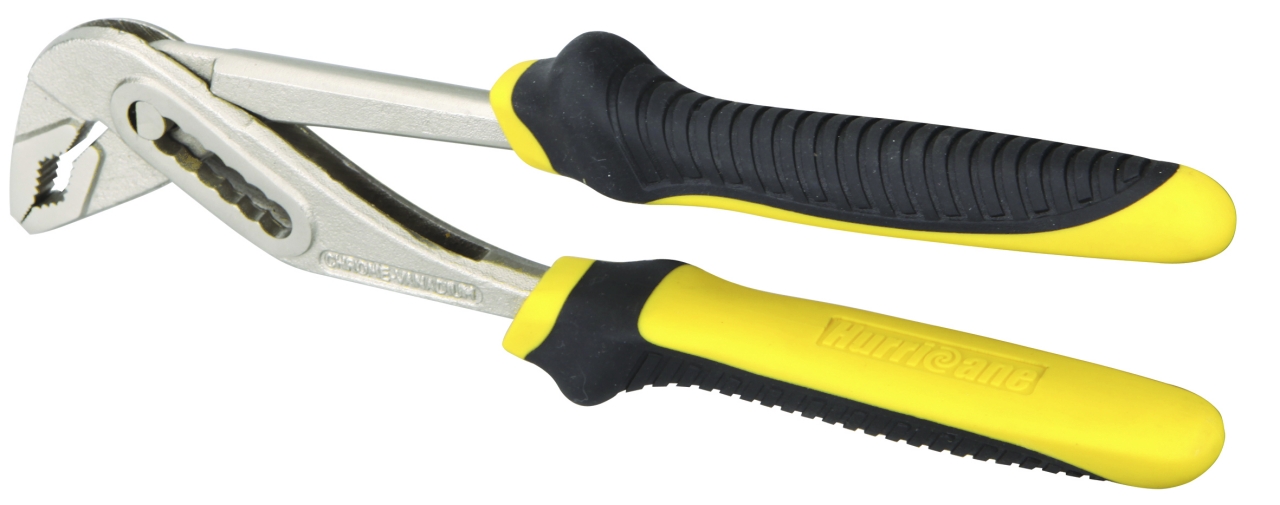
- مفتاح ربط قابل للضبط
It has a movable jaw that allows for size adjustments.
- Torque Wrench
It is calibrated to deliver exact torque measurements.
- Socket Wrench
Uses interchangeable sockets attached to a ratcheting handle.
Wrench Type Comparison
| Type | Precision | Grip Strength | Application |
| Open-End | Moderate | Lower | Quick access |
| Box-End | High | Strong | Secure fastening |
| Adjustable | Variable | Moderate | Multi-size use |
| Torque | Very High | Controlled | Critical torque |
| Socket | High | Strong | Fast repetitive work |
Materials Used in Wrench Manufacturing
Wrenches are typically made from:
- Chrome vanadium steel
- Chrome molybdenum steel
- Carbon steel alloys
Heat treatment enhances:
- Hardness
- Fatigue resistance
- Impact durability
Premium models feature corrosion-resistant chrome plating.
Manufacturing Process
The manufacturing quality of a wrench directly determines its strength, torque resistance, and lifespan. High-performance industrial wrenches typically go through the following stages:
- Material Selection
Most professional-grade wrenches are made from:
- Chrome vanadium (Cr-V) steel
- Chrome molybdenum (Cr-Mo) steel
- Carbon steel (for light-duty use)
Cr-V and Cr-Mo alloys provide higher tensile strength and impact resistance, which are critical for industrial torque applications.
- Forging
Drop forging is the most common production method. Heated steel billets are pressed under high pressure to form the wrench shape. This process:
- Aligns the grain structure
- Improves mechanical strength
- Reduces internal defects
Forged wrenches are significantly stronger than cast alternatives.
- Heat Treatment
Heat treatment optimizes hardness and toughness:
- Quenching increases hardness
- Tempering reduces brittleness
Proper heat treatment guarantees that the wrench will not deform when subjected to high torque.
- Machining and Finishing
Precision CNC machining improves jaw openings and tolerances. Surface treatments might involve:
- Chrome plating (corrosion resistance)
- Black oxide coating
- Phosphate coating
These finishes enhance durability and prevent rust.
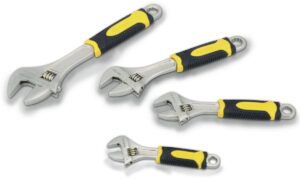
Ergonomics and Handle Design
Ergonomic design enhances efficiency and decreases user fatigue, particularly in professional settings.
Key Design Features
Contoured grips for a better fit in the hand
Anti-slip rubber overmolds
Balanced weight distribution
Extended handle length for leverage
Industrial users often prefer slimmer profiles for confined spaces, while maintenance technicians may prioritize comfort grips for repetitive use.
Industrial Applications of Wrenches
Wrenches are essential tools used in various industries:
- Automotive Repair
They are used for engine assembly, suspension maintenance, and brake system servicing.
- Construction
They are employed in structural bolt tightening, steel frame assembly, and plumbing installations.
- Manufacturing & Machinery
They facilitate equipment installation, maintenance, and repair operations (MRO), and servicing of heavy machinery.
- Oil & Gas / Energy
They are utilized for pipeline flange connections and pressure valve systems.
Wrench Size Standards
Wrench sizing standards differ depending on the region and application.
- Metric Sizes
They are common in Europe and Asia and are measured in millimeters (mm).
- SAE (Imperial) Sizes
These are typical in the United States and are measured in inches.
- Standardization Bodies
Wrench sizes are generally governed by international standards such as ISO (International Organization for Standardization), DIN (German standards), and ANSI (American standards).
Using the wrong size standards can cause bolt rounding or damage to equipment.
Common Metric Sizes
| Size (mm) | Typical Application |
| 8 mm | Small machinery |
| 10 mm | Automotive |
| 13 mm | General assembly |
| 17 mm | Vehicle wheels |
| 19 mm | Heavy-duty bolts |
Torque Wrenches and Calibration
Torque wrenches are precision tools used to apply a specific amount of torque to fasteners.
Types of Torque Wrenches
Click type
Beam type
Digital torque wrench
Importance of Calibration
Over time, torque accuracy can drift. Professional calibration:
Ensures compliance with safety standards
Prevents over-tightening
Maintains product quality
Industrial environments typically require annual or usage-based calibration cycles.
Safety Considerations
Using a wrench improperly can lead to injury or mechanical failure.
Key Safety Practices
Always select the correct wrench size for the fastener.
Avoid using cheater bars unless the tool is rated for it.
Whenever possible, pull instead of push.
Inspect for cracks or jaw wear.
Never use a wrench as a hammer.
Personal protective equipment (PPE), such as gloves and safety glasses, is recommended in industrial settings.
Common Mistakes When Using a Wrench
Using the wrong size
Pulling instead of pushing
Using an adjustable wrench on high torque
Over-tightening bolts
Ignoring torque specifications
Innovations in Wrench Design (2026 Trends)
Modern improvements include:
Anti-corrosion nano-coatings
Lightweight composite handles
Smart torque sensors
Laser-etched measurement scales
Non-sparking materials for hazardous environments
Digital torque monitoring systems are gaining popularity in industrial settings.
Traditional vs Smart Wrench Comparison
| Feature | Traditional Wrench | Smart Torque Wrench |
| Torque Feedback | Manual | Digital |
| Accuracy | User dependent | Calibrated |
| Data Logging | No | Yes |
| Cost | Lower | Higher |
How to Choose the Right Wrench?
Choosing the right wrench depends on various factors:
- Application Type
Light household repair
Automotive maintenance
Industrial heavy-duty tasks
- Torque Requirement
High-torque applications might need:
Box-end wrench
Impact wrench (powered)
Torque wrench
- Working Space
Open-end wrench for easy access
Ratcheting wrench for tight spaces
Offset wrench for deep-set bolts
- Material & Coating
In corrosive environments, opt for corrosion-resistant finishes like chrome plating or phosphate coating.
- Compliance and Certification
Industrial buyers should verify compliance with ISO, DIN, or ANSI standards to ensure quality and safety.
FAQ Section
- What is the main function of a wrench?
A wrench applies torque to tighten or loosen fasteners.
- How does a wrench create mechanical advantage?
It increases torque by extending the lever arm distance from the pivot point.
- What is the difference between a wrench and a spanner?
In many regions, “spanner” is simply another term for wrench.
- Why use a torque wrench instead of a regular wrench?
A torque wrench ensures precise tightening to prevent under- or over-tightening.
- What material is best for a wrench?
Chrome vanadium steel is widely preferred for strength and durability.
الخلاصة
A wrench is much more than just a basic hand tool—it is an essential mechanical device that relies on torque transmission and lever mechanics. It transforms applied force into precise rotational movement, allowing for secure and efficient fastening in nearly all mechanical fields.
In 2026, wrench technology keeps advancing through the use of advanced materials, ergonomic engineering, and smart torque integration. Whether for industrial procurement, professional repair, or high-performance mechanical assembly, choosing the appropriate wrench involves understanding torque physics, material strength, safety standards, and ergonomic design principles.
For organizations aiming to gain a competitive edge in manufacturing or distribution, investing in high-quality, precision-engineered wrench solutions improves performance reliability, worker safety, and long-term cost efficiency.